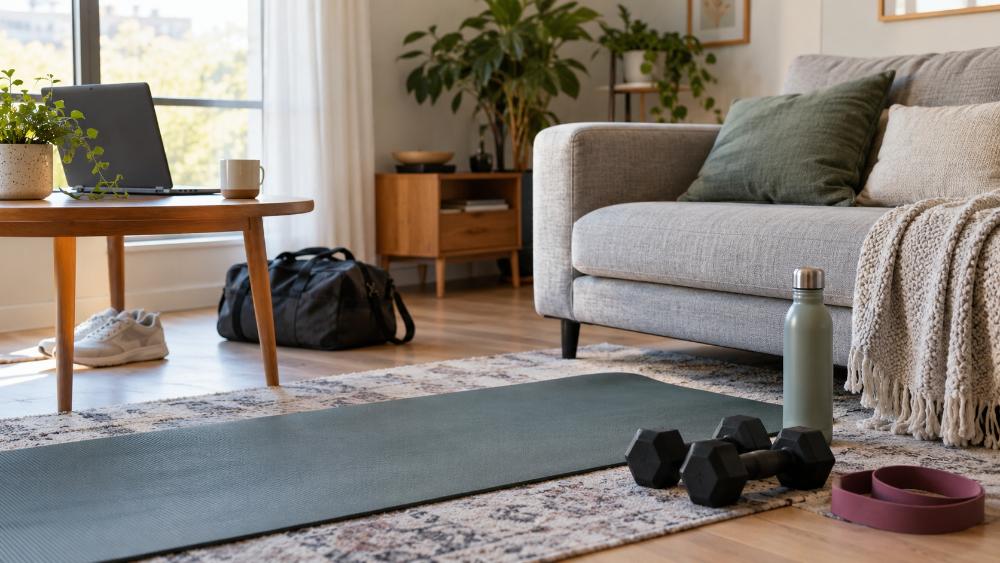
Build Fitness Around Your Life
A good training routine should fit your actual life. Learn how to reduce friction, use shorter sessions, and build a schedule you can realistically keep.
A fitness routine can look perfect on paper and still be a bad fit for your life.
Five workouts a week. Long sessions. Early mornings. A strict schedule.
It might work for someone else.
That does not mean it has to work for you.
A useful routine should fit the life you actually have.
Start with your real week
Before choosing a training plan, look at your schedule.
When do you realistically have time to train?
Which days are usually busy?
When do you have more energy?
Do you need to train at home because getting to a gym takes too much time?
Those questions matter more than copying a routine that looks impressive online.
If three sessions fit your week better than five, build around three.
If 40-minute workouts are realistic and 75-minute workouts are not, plan for 40.
Your routine should start with reality.
Remove unnecessary friction
Sometimes the hardest part of training is not the workout.
It is everything around it.
A gym that takes 30 minutes to reach.
A session that needs too much equipment.
A workout that only works if your day goes perfectly.
The more complicated it is to start, the easier it is to skip.
Small changes can help.
Keep equipment at home.
Choose a gym closer to work.
Prepare your workout before the session.
Reduce the number of decisions you need to make.
The easier it is to begin, the easier training becomes to fit into your week.
Shorter workouts still count
Not every day gives you an hour.
Sometimes you have 30 minutes.
Sometimes less.
That does not mean the workout has to disappear.
A short session with a few useful exercises can still be productive.
If time is limited, focus on the movements that matter most.
You do not need to squeeze every possible exercise into one session.
Instead of asking:
“Can I do my full workout today?”
Ask:
“What can I realistically do with the time I have?”
That question is much more useful.
Choose a frequency you can actually manage
There is no universal number of days everyone needs to train.
Three days might work very well for one person.
Four or five may fit someone else.
The right frequency depends on your goals, schedule, recovery, experience, and how much time you can realistically protect.
More days are only useful if they fit.
If your plan constantly forces you to skip sessions, rush through workouts, or move everything around, the problem may not be discipline.
The plan may simply be too demanding for your current week.
Busy weeks need a different version
Not every week will look the same.
Work gets busy.
Travel happens.
Family plans change.
Your schedule gets squeezed.
Instead of forcing your normal routine into a week that clearly does not support it, adjust it.
Reduce the number of sessions.
Shorten them.
Train on different days.
Keep only the main exercises.
That is not giving up on the plan.
It is making the plan usable.

Have a minimum version of your routine
One of the most useful things you can do is create two versions of your week.
A normal version.
And a minimum version.
Your normal week might include three full strength sessions.
Your minimum week might be two shorter sessions built around your main movements.
That gives you something realistic to fall back on when life gets busy.
It also removes the idea that if you cannot do everything, there is no point doing anything.
The minimum version is not there to replace your normal routine.
It is there to keep training connected to your life when your schedule changes.
Let the plan change when your life changes
The routine that works for you now may not work forever.
Your schedule changes.
Your responsibilities change.
Your goals change.
Your available equipment may change.
Your training can change too.
A good plan should be stable enough to follow, but flexible enough to adapt when your circumstances change.
That is not inconsistency.
That is good planning.
Build the routine you can actually use
You do not need the longest workouts.
You do not need the most demanding schedule.
You do not need to train the same way as someone else.
You need a routine that makes sense inside your actual week.
Look at your time.
Reduce friction.
Keep a shorter option for busy days.
Choose a frequency you can realistically manage.
Adjust when life changes.
The goal is not to make training take over your life.
It is to make training fit into it well enough that you can keep using it.